
Assessment Tools for
All co-developed by
TAKE DR. KILMANN’S
ASSESSMENTS TO LEARN
HOW YOU CAN BETTER MANAGE
CONFLICT, CHANGE, CONSCIOUSNESS
AND QUANTUM TRANSFORMATION
Kilmann Diagnostics is the exclusive provider of online training and certification for interpreting the Thomas-Kilmann Instrument (TKI). Along with co-developing the TKI assessment, Dr. Kilmann has also authored seven additional self-report assessment tools that highlight the underlying dynamics of transformation: Culture-Gaps, Time-Gaps, Team-Gaps, Organizational Beliefs, Organizational Influence, Organizational Courage, and Organizational Conflict. All these assessment tools are discussed throughout our integrated series of online courses, since these assessments enable participants to become much more aware of the key role they play in achieving organizational success and personal meaning.
Assessing Conflict-Handling Behavior
ONE TKI FOR YOURSELF:
INDIVIDUAL REPORT
The TKI assessment for yourself reveals which of the five conflict modes (competing, collaborating, compromising, avoiding, and accommodating) you might be using too much or too little…or just right—so you can improve how you manage conflict in the future.
TKIs FOR A GROUP:
INDIVIDUAL REPORTS
The TKI assessment for a group of participants reveals which of the five conflict modes (competing, collaborating, compromising, avoiding, and accommodating) they might be using too much or too little…or just right—so they can improve their conflict-handling behavior.
TWO TKIs PER PERSON:
INDIVIDUAL REPORTS
By taking one TKI for INSIDE your group and another TKI for OUTSIDE your group, you and/or a group of participants will discover how the leader, the culture, and the reward system might be having undue influence on how conflict is being managed INSIDE the group.
TKI Team Reports for
ESTABLISHED TEAMS
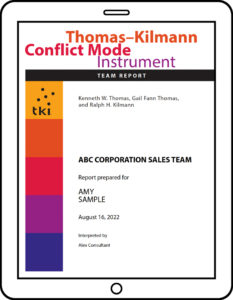
After all team members complete their TKI, every member will receive a personalized report that uncovers the particular OBSTACLES to effective conflict management along with several recommended REMEDIES for improving their team’s performance and satisfaction.
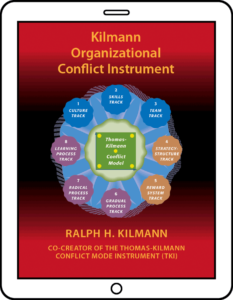
Kilmann ORGANIZATIONAL
Conflict Instrument (KOCI)
The KOCI reveals how often you are being negatively affected by the various systems conflicts in your organization (e.g., culture, strategy-structure, and rewards) and which conflict modes you tend to use too much or too little for resolving those systems conflicts.
Assessing Culture
Culture-Gap®
Survey
This assessment allows you to discover the differences between actual and desired cultural norms in four areas: task support, task innovation, social relationships, and personal freedom. Once identified, a group can take steps to close these culture-gaps.
Assessment Tools for
Courage, Beliefs, and Influence
Organizational Courage Assessment
This assessment relies on two dimensions (observing acts of courage and fearing acts of courage) to define four organizations. Steps can then be taken to transform a fearful or bureaucratic organization into a more courageous or quantum organization.
Organizational
Belief Survey
This survey assesses if you believe that your performance is largely determined by outside forces (such as your boss or coworkers) or by inside forces (your own decisions and actions). The results lead to new beliefs that encourage greater personal empowerment.
Organizational Influence Survey
This survey assesses whether you have the right balance of influence over the key aspects of your job that determine your performance and satisfaction. If you have too little (or too much) influence, steps can then be taken to create the right balance.
Assessing Time-Gaps and Team-Gaps
Time-Gap
Survey
This survey pinpoints five key areas in your work life in which you might not be making the best use of your time. The results then suggest how you can reallocate the time your spend on tasks and activities in order to achieve your group or organization’s goals.
Team-Gap
Survey
This survey looks at the differences between actual and desired behavior in four key areas: cultural norms, people management, problem management, and time management. If any of these four team-gaps are significant, members can then close these gaps.